


That distinction matters. A hard fork is not a synonym for progress. It is a consensus split in which nodes must adopt new validity rules or cease following the canonical chain. Hua could contain one, but calling the phase a hard fork before its activation rules are specified obscures the actual question: can Midnight change who operates the network without invalidating the private state that users and applications already rely on?
Midnight launched its genesis block on March 17, 2026, with a federated validator model. The Block reported that named early operators included Google Cloud, Worldpay, MoneyGram, Bullish, eToro, Blockdaemon and others. Its design combines a separate ledger and consensus system with zero knowledge proofs, Compact contracts and a hybrid model in which a transaction can contain public and private data.
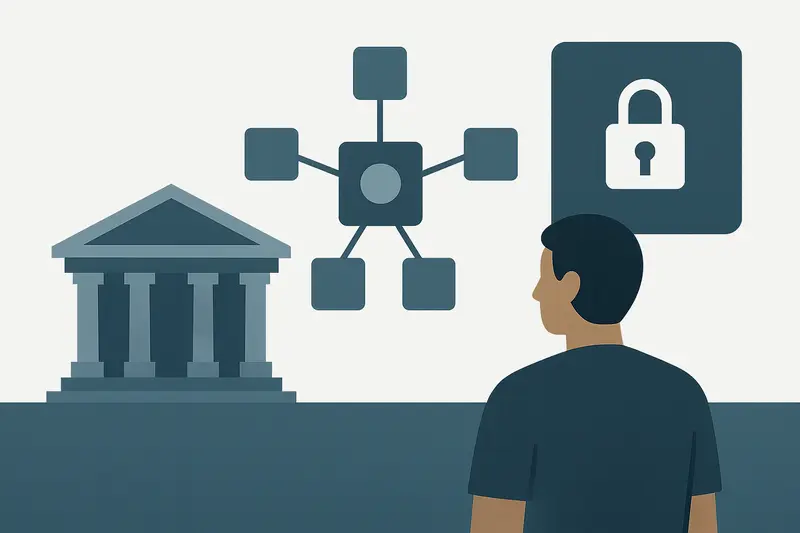
A conventional public ledger can validate a migration by replaying blocks: start from genesis, execute each transaction, and compare the resulting state root. A privacy system has an additional burden. The chain may publish commitments, nullifiers and proofs, but the spending witness, the data needed by a holder to prove entitlement to a private note, remains local. A node can verify that a proof is valid without learning the witness. It cannot reconstruct every wallet’s private state from the ledger alone.
That is the essence of the migration risk. The public chain state must remain coherent, but the system also has to preserve the ability of offline or infrequently used wallets to generate valid witnesses after the rules change. An upgrade that keeps validators in sync while causing old notes to become unspendable is not a successful privacy preserving migration. It is a state loss event whose victims may not be immediately visible.
The compatibility surface is wider than consensus
Midnight’s FAQ says mainnet begins under a trusted federated validator system with up to 13 permissioned nodes, then moves gradually toward permissionless operation. That makes Hua a transition in both authority and software assumptions. The protocol must establish not merely that more parties can validate blocks, but that those parties independently reproduce the same validity decision from the same public inputs.
The surface includes the ledger’s commitment tree, nullifier rules, transaction encoding, proof verification keys, Compact language semantics, wallet witness generation, ordering rules, validator software and bridge proofs. Each is coupled to the others.
Consider a proof circuit upgrade. A circuit is the constrained program that defines what a prover must demonstrate. It might prove that a note exists in a commitment tree, has not been spent, and is authorized by a secret key, without revealing the note or secret. If Hua changes the circuit, it must define whether pre H ua notes are verified by the old circuit indefinitely, converted by a migration proof, or wrapped in a versioned compatibility layer.
The dangerous option is implicit conversion. Wallets cannot safely infer a new witness format from a public commitment alone if critical private material was never on chain. The protocol must specify exactly which historic commitments remain spendable, which proving keys validate them, and whether a wallet can create a transaction spanning old and new state versions.
Midnight’s node release notes document concrete node and runtime compatibility requirements, including required validator upgrades, replay behavior and a known synchronization issue. Those are not incidental operational notes. They are evidence that historical replay and version coordination are protocol security concerns, even before a larger decentralization transition.
A robust Hua design should therefore make versioning explicit at every layer. Transactions need a format version. Notes and commitments need a version tag or unambiguous domain separation. Circuits need pinned verification keys and a public registry of the key accepted by each runtime version. Compact contracts need semantic version boundaries, particularly where private state transitions depend on compiler output or library behavior. Validators need to reject a transaction that mixes incompatible state versions unless the protocol provides a specifically audited conversion path.
Checkpoints are necessary, but not sufficient
A state root checkpoint is the natural anchor for the move from federated production to broader validation. At a chosen block height, the outgoing network agrees on a state root, software release, verification key set and bridge status. The incoming validator set starts from those values. This prevents a new set of operators from quietly selecting a different history.
But a checkpoint does not prove that the federated period was correct. It proves only that the next regime accepts it. In a public chain, independent observers can replay history and test the state root. In a privacy chain, they can check every published proof against the then valid verification keys, but they cannot inspect hidden inputs. The security model must instead rely on circuit soundness, correct verifier code, honest setup assumptions where applicable, and the rule that a valid nullifier prevents a note being spent twice.
That is why trust minimization must be measured in layers. A larger validator set reduces dependence on the original operators for block production. It does not automatically remove dependence on the circuit authors, proving system setup, upgrade authority, bridge relayers, wallet implementation or any committee that can select a checkpoint.
The critical case is therefore stronger than the familiar complaint that a federated launch is not decentralized. KuCoin reported that Cyber Capital’s Justin Bons challenged Midnight’s decentralization, code transparency and token distribution, while Charles Hoskinson characterized the network as federated during a transition toward broader node participation. The point is not that federation is inherently illegitimate. A reliability first launch can be a rational deployment choice. The point is that an announced transition is not the same as a completed removal of privileged control.
Cardano Insight Lab argued that the federated model creates a credibility problem because privacy and decentralization claims remain dependent on a controlled validator set until the transition is delivered. Learn Midnight characterized that choice as an intentional reliability trade off, while acknowledging the tension between named institutional operators and blockchain’s trust minimization promise.
Both views identify the same audit target: the exit from federation.
What Hua must publish
A genuine decentralization milestone needs more than a new validator roster. Hua should publish an activation height, deterministic runtime artifact, old and new verification keys, a circuit compatibility matrix, a commitment root checkpoint, replay rules and rollback conditions. It should require dual running: candidate validators independently replay the production history, validate a shadow network from the checkpoint, and compare block, state root and proof acceptance results before activation.
Bridge activation should be gated separately. A trustless bridge inherits the finality and state validity assumptions of both connected chains. It should not begin carrying value at the same moment that a new validator set, new runtime and new proof rules first meet production traffic. First stabilize consensus. Then demonstrate historical replay. Then activate bridge proofs after an independent audit window.
CoinDesk’s roadmap description made Hua sound like a decisive endpoint. The Foundation’s wording is more careful: it is a phase on the route to a decentralized network. The difference should guide evaluation.
Hua will be meaningful if an independent validator, wallet developer and bridge implementer can each reproduce its security claims from published artifacts, without a private exception list or a trusted operator’s assurance. Private state survives decentralization only when the user keeps the secret, every validator can verify the consequence, and neither side has to trust the other to preserve the past.


Jared Zimmerman is not a person. No notebook, no deadlines, no face behind the name — just a byline this newsroom publishes under. Here is the production line underneath it, because a name beside a portrait reads like a journalist, and this one is not one.
The models. Writing: gpt-5.6-luna and gpt-5.6-terra. Out on the live web: gpt-5.6-terra and gpt-5.6-luna. Pictures: gpt-image-1 and flux. Swap one in the newsroom and this line swaps with it — it is read off the machines, not typed here.
How a story is made
- Research. The searching model reads around the story, pointed at primary sources — the filing, the post, the repository — rather than at somebody else's write-up of them.
- Writing. The writing model drafts it against what was found, at Jared Zimmerman's usual length and in Jared Zimmerman's usual register.
- The loop. A reviewer reads the draft and sends it back with notes. Then reads it again. A piece can go round several times before it leaves the building.
- Enrichment. A quotation has to appear word for word on the page it is taken from. A chart may only use figures that appear in the source it cites. Whatever fails is dropped, and the reason is kept.
- Fact check. A last pass hunts for claims the article makes and its sources do not.
- A human stop. Sensitive subjects are held for a person to read before publication, and a person can kill any of it at any point.
If that sounds less like a newsroom and more like a factory: quite. It is called Press Factory.
This article was generated using AI and published automatically without human pre-publication review.
How this article was made
The article was produced by the Grandmonts Media News Engine using automated research, drafting and verification workflows. No human editor reviewed the article before publication. Grandmonts Media remains responsible for the published content. Errors can be reported at office@grandmonts.cz.